Scenic Areas in Mount Huangshan
A quick note about the division of scenic areas — The official management of Huangshan divides the mountain into several core zones for planning and conservation purposes. Depending on the source, you may see references to seven, eight, or nine distinct scenic areas. This guide follows the comprehensive nine-area classification, which is widely used in detailed travel resources, including Beihai, Xihai, West Sea Grand Canyon, Tianhai, White Clouds, Jade Screen (Yuping), Pine Valley (Songgu), Cloud Valley (Yungu), and Hot Spring. However, in many official summaries, Yuping, Baiyun, and Yungu are folded into broader groupings, giving a seven-area count. Either way, the coverage here reflects all the essential hiking routes and viewpoints you can visit today.
A UNESCO World Heritage Site (inscribed 1990) and UNESCO Global Geopark, Huangshan is a sprawling wonderland of granite peaks, ancient pines, seas of clouds, and hot springs.
The table below helps you quickly compare the core scenic areas and plan your route.
| Scenic Area | English Name / Location | 2026 Status & Key Attractions | Estimated Time |
|---|---|---|---|
| Beihai (North Sea) | Rear Mountain – Back Mountain Access | Shixin Peak, Lion Peak, Monkey Watching the Sea. Must‑visit entry point for first‑time hikers | 2–4 hours |
| Xihai (West Sea) | West Side – Paiyun Pavilion Area | Paiyun Pavilion (sunset), Flying‑over Rock, panoramic views. Closed in winter (Dec–mid‑Mar) | 2–3 hours |
| West Sea Grand Canyon | Within Xihai – Canyon Floor | Plank walks, sheer cliffs, popular mini‑train. Also called Baiyun Valley | 3–5 hours |
| Tianhai (Heavenly Sea) | Central high plateau – Bright Summit Base | Bright Summit (1860m, second highest), one of the best sunrise/sunset spots. Highest chance of sea of clouds | 1–2 hours |
| White Clouds (Baiyun) | Southern canyon – Step Fairy Bridge Area | Step Fairy Bridge, Qianxun Falls (tallest, ice‑free year‑round). Secluded, fewer crowds | 2–3 hours |
| Yuping (Jade Screen) | Front Mountain – Welcoming Pine Area | Welcoming Pine (1,500+ years old), Lotus Peak (1864.8m – open in 2026), Tiandu Peak (closed from April 2026 onward for 3–5 years) | 3–6 hours |
| Songgu (Pine Valley) | North Gate – Hidden Cultural Gems | Taiping Cableway (Asia‘s longest), Songgu An (Song Dynasty ruins), Jade Pool, Wulong Pavilion. Off‑peak, lesser‑known | 1–2 hours |
| Yungu (Cloud Valley) | East Side – Rear Mountain Access | Yungu Cableway, Cloud Valley Temple, Nine Dragons Waterfall (9‑tier), Emerald Valley | 2–4 hours |
| Hot Spring | South Gate – Base of the Mountain | Natural hot springs (42°C year‑round), Renzi Falls (Inverted “V”), Baizhang Spring. Ideal for pre‑ or post‑hike | 1–3 hours |

1. Beihai (North Sea) Scenic Area – The Heart of the Rear Mountain
The Beihai Scenic Area is the core of Huangshan‘s Rear Mountain (Back Mountain) region, located just a few kilometers from the Paiyun Pavilion in the West Sea, with the Xihai Hotel along the way. The Beihai Hotel sits near Lion Peak at an elevation of 1,630 meters, making it a convenient base for exploring this area.
From the Dawn Pavilion in front of the hotel, you can enjoy the beautiful scenery of Shixin Peak (Beginning‑to‑Believe Peak) and the Stalagmite Bridge, which inspires imagination of all kinds of fairy scenes. To the right of the hotel is the Flower House; in front of it lies the Sunken Flower Valley, filled with rocks of fantastic shapes.
The Refreshing Terrace, reached by turning left from the hotel past the Unicorn Pine, extends out from the cliff and offers sweeping views in three directions — an ideal place for watching sunrise and sea of clouds. From the Cooling Apex atop Lion Peak, you can look down at Pingding Hill, which is famous for the “Monkey Watching the Sea” rock formation — a silhouette of a monkey gazing out over a vast expanse of clouds. Below Lion Peak, the Ten Thousand Pines Forest sends out a constant pine soughing.
Turning right from the guesthouse, you cross the Immortal Bridge and ascend Shixin Peak, where a magnificent view of stalagmites unfolds. The name Shixin (“Beginning‑to‑Believe”) comes from a famous legend: a visitor who had doubted the tales of Huangshan‘s beauty climbed this peak and was instantly converted. Shixin Peak is also renowned for its dense, ancient pine forests and is an excellent spot for photography, particularly in soft morning light. The local saying goes: “Without seeing Shixin Peak, you haven’t truly seen Huangshan pines.”
2026 Update: From Beihai, you can connect directly to the West Sea Grand Canyon via Paiyun Pavilion. A popular 2‑day itinerary enters from the South Gate, takes the Yungu Cableway up to Beihai, then proceeds to Shixin Peak → Lion Peak → Paiyun Pavilion → the canyon before overnighting at a summit hotel.

2. Xihai (West Sea) Scenic Area & the Grand Canyon
The West Sea region is famous for its dramatic clusters of peaks and fathomless valleys. From Bright Summit, descending via a newly opened tourist route brings you into the West Sea, where the mystical Flying‑over Rock (Feilai Stone) — a 10‑meter‑high boulder weighing 600 tons perched precariously on a cliff edge — first comes into view.
Continuing past nearby peaks, you arrive at Paiyun Pavilion (Cloud‑dispelling Pavilion) , which commands an excellent view of the unfolding scene. From the pavilion, you gaze out at a sea of variously shaped peaks that inspire all sorts of fairy imaginations — a natural art gallery carved by nature itself. When the sun sets, the entire valley basks in a myriad of sun rays, making it a famous sunset spot on the mountain. Equally impressive is the 1,712‑meter Rosy Cloud Peak behind the pavilion, where you can watch the sun rising above the clouds with Flying‑over Rock and Nine Dragon Peak in full view.
* West Sea Grand Canyon (Xihai Grand Canyon) – The “Fantastical Scenic Area”
Long known as the “Mystery Valley” for its deep ravines and jagged peaks, the West Sea Grand Canyon opened to the public in May 2001 and has since become Huangshan’s most talked‑about hiking destination. Covering the most prime scenery of the West Sea, it starts at Paiyun Pavilion, links to the White Clouds Area at Step Fairy Bridge, and creates a breathtaking circular sightseeing route.
What makes the canyon special:
• Plank Walkways: Trails clinging to the sides of sheer cliffs, with stairs that seem to hang over the abyss. When you walk on the steep steps, every step reveals a breathtaking view — you can point your camera and take a perfect shot almost anywhere along the way.
• Unique Rock Formations: Named formations include Upside‑down Boot, Lady Playing Piano, Dog Watching Sky, and Immortal Walking on Stilts. Fantastic peaks such as Archway Peak, Nine‑dragon Peak, Double Bamboo Shoot Peak, and Stone‑pillar Peak rise around you.
• The “Popular Little Train” (Canyon Rail): Opened in 2013, this 892‑meter track‑based sightseeing rail has an average slope of 34 degrees and takes about 8 minutes one‑way. The transparent glass carriages offer stunning views of the canyon walls, particularly when the train passes through sea of clouds — a scene that has earned it the nickname “mini‑train through the clouds”.
• Seasonal Closure: The canyon closes for the winter from December to mid‑March due to ice hazards on the cliff‑hanging walkways. On March 14, 2026, it reopened for the season.
2026 circular route (2.5 hours): Paiyun Pavilion → First Ring Road → Second Ring Road → Paiyunxi Station → Take the sightseeing rail to Tianhai Station → Walk to Baiyun Hotel to continue your itinerary.
Pro tip: The best strategy is to hike down into the canyon (saving your knees), explore the loops, then take the mini‑train back up to Tianhai. This is the most efficient and physically comfortable way to experience the canyon without exhausting yourself.

3. Tianhai (Heavenly Sea) Scenic Area – The Central Hub
Tianhai Scenic Area sits at the high plateau right between the western and eastern parts of Huangshan. There is a botanic garden nearby where you can see many plants indigenous to Mount Huangshan, making it a great spot to pause and appreciate the mountain’s biodiversity. Many climbers — especially those trekking up from the western side — take a break here to regain energy, as this generally flat area has a few shops for basic supplies.
Aside from the botanic garden, Tianhai features Heavenly Sea Pavilion, a granite pavilion with sweeping views, and Heavenly Sea Pond, a serene water feature. From here, less than half an hour‘s walk uphill will lead you to Bright Summit, the second‑highest peak on the mountain.
Tianhai is also a key junction for adventurers trekking the Grand Canyon — you’ll cross Step Fairy Bridge (more on that below) to reach Tianhai before completing the full canyon loop, which takes about 5–6 hours total.
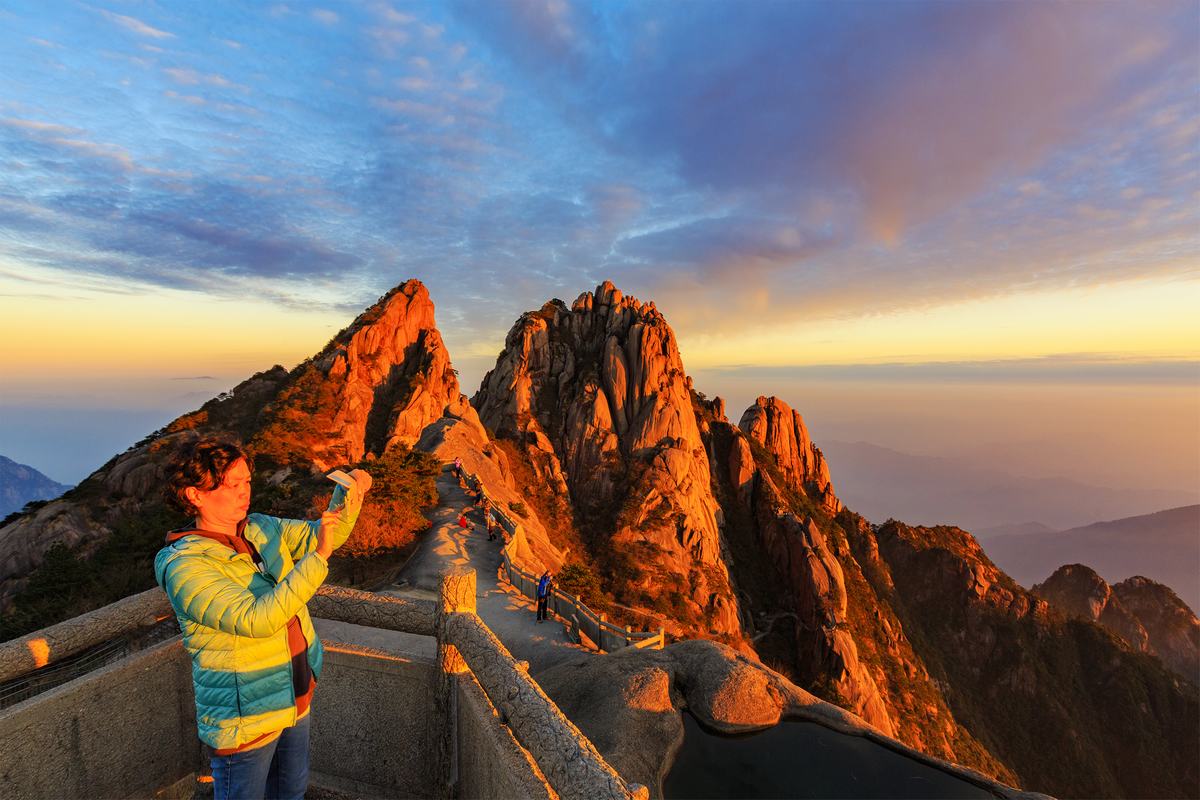
4. White Clouds (Baiyun) Scenic Area – The Secluded Canyon Route
The White Clouds (Baiyun) Scenic Area — also called Baiyun Valley — was carved out of what was once the “Mystery Valley” of the West Sea. A seven‑kilometer long newly paved staircase of granite steps now extends from Hook Bridge Nunnery inside the West Gate, across the bottom of the valley, and reaches the newly built Central Sea Pavilion at Tianhai. This route offers some of the most secluded and pristine scenery on the mountain, with far fewer visitors than the main front/rear mountain corridors.
Highlights include:
• Qianxun Falls: The highest waterfall in Huangshan, with a 140‑meter drop. Remarkably, it is ice‑free all year round — the cascading water thunders even in winter. You can hear the falls from Swan Rock near the brook.
• Immortal Walking on Stilts: A striking rock formation near the falls that resembles a figure striding on stilts — another example of Huangshan’s famously imaginative rock‑naming tradition.
• Step Fairy Bridge (Walking Fairy Bridge): A narrow stone bridge connecting cliff faces deep in the canyon. Crossing it feels like stepping from the human world into a land of immortals — a classic Huangshan moment.
• Goddess Flower Bed: A cluster of oddly shaped rocks that evoke an image of a goddess‘s floral arrangement.
On the way, you can watch pines in all kinds of odd shapes — some twisted, some straight, some clinging to rock faces with roots exposed, each with its own character.

5. Yuping (Jade Screen) Scenic Area – Icons of the Front Mountain
The Yuping Scenic Area is the crown jewel of Huangshan’s Front Mountain. The Jade Screen Pavilion (Yupinglou) stands against the 1,668‑meter‑high Jade Screen Peak. Originally the site of Manjusri Temple (a Buddhist temple named after the Bodhisattva of Wisdom), it is now a tourist center with complete service facilities, including a hotel, restaurant, and shops. Around the pavilion are elephant‑ and lion‑shaped rocks and ancient pines that guard the area like celestial sentinels.
The Welcoming Pine (Guest‑Greeting Pine)
To the left of the pavilion stands the most famous tree in China: the Welcoming Pine (Yingke Song) . This 1,500‑year‑old Huangshan pine grows horizontally out of a vertical cliff face, its branches stretching forward like a host greeting arriving guests. It has become a symbol of Chinese hospitality and is one of the most photographed spots on the mountain.
From the Welcoming Pine, you can see on the left Celestial Capital Peak (Tiandu Feng) and Ploughing Cloud Peak. On Ploughing Cloud Peak, there is a rock that looks like a squirrel jumping toward Celestial Capital Peak, and below, another oddly shaped rock conjures up a scene of an immortal getting off a sedan chair. To the right of the pavilion are Lotus Peak, Lotus Pistil Peak, and Holy Spring Peak. Viewed from a distance, the rock on Lotus Pistil Peak looks like a small boat sailing through the ocean of clouds, while another rock beside the peak resembles a peacock playing in the lotus.
* Lotus Peak (Lianhua Feng) – Highest Point of Huangshan (1864.8m)
Yes — Lotus Peak is open in 2026!
Lotus Peak is the absolute highest point in the entire Huangshan Scenic Area. After a five‑year ecological closure, it reopened in March 2026 and is welcoming hikers this season. Its name comes from its resemblance to a lotus blossom, with smaller peaks clustered around a large central summit. The trail to the top is steep and challenging but rewarding, offering stunning 360° views of the surrounding peaks and, on clear days, the sea of clouds rolling below.
Lotus Peak lies between Yuping Pavilion and Bright Summit, facing Tiandu Peak to the east.
* Tiandu Peak (Celestial Capital Peak) – Currently Closed
Unlike Lotus Peak, Tiandu Peak is currently closed and is not accessible for hiking in 2026. The mountain operates a rotation system for its two highest peaks: Tiandu Peak and Lotus Peak alternate opening periods every 3–5 years for ecological recovery.
• Lotus Peak = OPEN in 2026
• Tiandu Peak = CLOSED from approximately April 2026 onward, with no set reopening date yet — early expectations point to a 3‑to‑5‑year closure period
If you see online itineraries mentioning “climbing Tiandu Peak” in 2026, be aware they are outdated. Plan your trip around the open Lotus Peak instead, which offers an equally spectacular — and arguably more famous — summit experience.
Step Fairy Bridge (Xianren Qiao) – A Photographer’s Dream
Located in the Yuping area, Step Fairy Bridge is a narrow stone crossing between cliffs. When mist flows through the canyon below, the bridge appears to hover above a sea of clouds — an aerial shot that every photographer dreams of capturing. It is best visited in early morning (6:00–8:00 AM), when the light is soft and the mist is still thick.

6. Songgu (Pine Valley) Scenic Area – The Hidden Cultural Gem at the North Gate
The Songgu Scenic Area covers about 13 square kilometers at the northern foothills of Huangshan, near the lower station of the Taiping Cableway (Songgu An) . While most visitors overlook this area in favor of the dramatic South Gate peaks, Songgu is a hidden treasure that rewards those who make the journey.
What makes Songgu special:
• Taiping Cableway: The longest cable car in Asia — 3,709 meters in length, with a height difference of over 1,000 meters — departs from Songgu An and climbs to Pine Forest Peak. A single carriage holds up to 100 people (plus one attendant) and the ride takes about 8 minutes.
• Songgu An (Pine Valley Nunnery): Originally built in the Song Dynasty (1253 CE) , this nationally protected cultural relic was originally named Songgu Caotang, built by the Songgu Daoist. It was rebuilt and converted into a Buddhist temple during the Ming Xuande period (1426 CE) and renamed Songgu An.
• Jade Pool (Yutan): A crystal‑clear creek pool so green and pure that the water is named jade. Ancient stone carvings can be found on valley boulders and cliff walls around the pool.
• Wulong Pavilion: A Ming Dynasty relic and nationally protected cultural site, built on a giant rock in Wulong Pool. The pavilion pillars bear the couplet: “Cloudy mountains surround on all sides, two waters encircle, a pool reflects stars and moon on the solitary pavilion.”
• Five Dragon Pools (Black, Green, White, Jade, Old Dragon): Five giant rocks naturally shaped like dragons stretching their heads to drink water, hence the name.
Good to know: There is no separate admission fee for the Songgu Scenic Area alone — you only pay for Huangshan entrance and the cableway if you continue into the main park. If you don‘t want to enter Huangshan‘s main ticketed area, you can still hike the 1.6‑km gentle trail around Songgu An for about an hour, then walk back 500 meters to the cableway station. For transportation, the nearest high‑speed rail station is Huangshan West Station, 20 km from the North Gate parking lot, with shuttle buses running 8:00 AM – 4:00 PM daily.

7. Yungu (Cloud Valley) Scenic Area – The Gentle Eastern Gateway
To reach the Cloud Valley Scenic Area — where the Yungu Cable Car Station is located — you turn left from Beihai Hotel and go eastwards. Passing the Black Tiger Pine, you reach White Goose Ridge (Bai‘e Ling) , with the beautiful and steep White Goose Peak standing to the left. White Goose Ridge is the terminal for the 2,666‑meter cable car route between Cloud Valley Temple and the North Sea.
Yungu Cableway: Completed in 2006, it runs from Cloud Valley Temple to White Goose Ridge in about 8 minutes. The route offers a bird‘s‑eye view of the East Sea (one of the five directions of Huangshan’s sea of clouds) and passes by or near Shixin Peak, Monkey Watching the Sea, and Refreshing Terrace. The cableway has 69 eight‑seat gondolas and can move up to 2,000 people per hour.
Cloud Valley Temple (Yungu Temple): Situated at 890 meters above sea level, between Arhat Peak and Incense Burner Peak, the temple was built during the Ming Wanli period (1573–1620 CE) and was renamed during the Chongzhen era (1627–1644). It is roughly halfway between the North Sea and the Hot Spring Scenic Area along the mountain route. Tourists may stay at the Cloud Valley Hotel, which is built in the traditional local architectural style of the Ming Dynasty and provides comfortable service. Here, you can also see rare aged yellow Chinese fir and iron Chinese fir, and enjoy Huangshan Maofeng, one of China‘s ten most famous green teas.
Nearby attractions accessible from Yungu:
• Nine Dragons Waterfall (Jiulong Pu): A spectacular nine‑tiered waterfall located about 4 km from the temple, reached by descending the mountain path to the left of Cloud Valley Temple and passing through a bamboo grove. In summer, the water flow is at its peak (July–August).
• Emerald Valley (Jadeite Valley): The filming location of Crouching Tiger, Hidden Dragon, famous for its 100 jade‑green pools and the “Lover‘s Valley” moniker. Only about 10–15 minutes by car from Cloud Valley Temple.
• Hundred‑Foot Waterfall: On the way back from the temple, you can stop to watch this thundering cascade at close distance before returning to the Hot Spring area.

8. Hot Spring Scenic Area – The Nourishing Gateway
The Hot Spring of Huangshan has been famous for over a thousand years. Gushing forth from the foot of Purple Cloud Peak, it has never run dry during the most severe droughts nor overflooded during excessive rain. The water is of a high‑temperature carbonate type, with therapeutic effects for metabolic disorders, cardiovascular disease, and malfunctions of the digestive, nervous, and motor systems. Its clear water remains at a soothing 42°C (107.6°F) all year round.
The Hot Spring Scenic Area sits at 630 meters above sea level and includes a large tourist complex: Hot Spring Hotel, Taoyuan Hotel, Xuanyuan Hotel, the Hot Spring Bath, the Postal Telecommunications Building, villas, and tourist shops. The area straddles Peach Blossom Brook, which flows between Purple Cloud Peak and Peach Blossom Peak. Across the brook are the Purple Cloud Bridge, the Scenery Watching Bridge, the Famous Spring Bridge, and the White Dragon Bridge. Scattered around are the Fish Watching Pavilion, Falls Watching Pavilion, and Peach Blossom Land Pavilion.
Key waterfalls in the Hot Spring area:
• Renzi Falls (人字瀑 — “Inverted V Falls”): A spectacular waterfall that splits into two parallel streams, resembling the Chinese character “人” (person). It’s one of the most photographed waterfalls on the mountain.
• Hundred‑Foot Waterfall (Baizhang Pu): A powerful cascade that drops dramatically down a sheer cliff face, visible from the main route.
• Other viewpoints: From here, you can also see Celestial Capital Peak, Lotus Peak, Cinnabar Peak, and Purple Cloud Peak, as well as Roaring Lion Rock, Dragon Head Rock, Tiger Head Rock, Intoxicated Rock, and Sword Testing Rock.
Gateway to the mountain: The Hot Spring area is the main departure point for ascending the Front Mountain. From here, travelers can take two routes for mountain sightseeing: the Western Steps (ascend the steep front mountain and descend the more gentle back mountain) or the Eastern Steps (the opposite). Most visitors today, however, take the shuttle bus from the South Gate Transfer Center in Tangkou Town to either Yungu Cableway (Rear Mountain) or Yuping Cableway (Front Mountain), bypassing the Hot Spring area until the end of their hike.

9. Practical 2026 Visitor Information
2026 Tickets & Prices:
| Item | Peak Season (Mar – Nov) | Off‑Season (Dec – Feb) |
|---|---|---|
| Entrance Ticket | 190 RMB (valid 3 days) | 150 RMB (valid 3 days) |
| Yungu Cableway (Rear Mountain) | 80 RMB one‑way | 65‑75 RMB one‑way |
| Yuping Cableway (Front Mountain) | 90 RMB one‑way | 65‑75 RMB one‑way |
| Taiping Cableway (North Gate) | 80 RMB one‑way | 65 RMB one‑way |
| West Sea Grand Canyon Rail | 100 RMB one‑way | Closed (Dec – mid‑Mar) |
Prices subject to change. Check official channels for the latest.
Operating Hours (2026):
| Season | Weekday | Weekend & Holidays |
|---|---|---|
| Peak Season (Mar – Nov) | 7:00 – 17:10 | 6:30 – 17:40 |
| Off‑Season (Dec – Feb) | 8:00 – 16:40 | 8:00 – 16:40 |
The scenic area hiking entrances close at 15:00 for safety management. Plan your ascent accordingly — if you arrive late, you may be denied entry.
How to avoid crowds:
• Most visitors enter from the South Gate and take either Yungu or Yuping Cableway. The South Gate can have queues of 1‑2 hours on weekends and holidays.
• Use the North Gate (Taiping Cableway) instead if you value solitude. It serves only about 30% of the visitors but accesses the same core peaks via Pine Forest Peak.
• Start early: Arrive at the cableway station before 7:00 AM (or 6:30 AM on weekends) to beat the tour groups.
• Back‑mountain → front‑mountain route: Enter via Yungu Cableway (gentler terrain, fewer people) and exit via Yuping Cableway. This route follows the sun, avoids the worst of the crowds, and reduces knee strain from steep descents.
• Visit on weekdays, especially Tuesday–Thursday. The difference in crowd levels between a Tuesday and a Saturday is dramatic.
• Avoid Chinese public holidays: National Day (Oct 1–7), Labor Day (May 1–5), and Spring Festival should be avoided unless you have no choice.
2026 peak opening status update — important!
• Lotus Peak (highest point, 1864.8m): OPEN in 2026 — after a five‑year ecological closure.
• Tiandu Peak (second highest, 1810m): CLOSED — entered its own 3‑to‑5‑year rotation from April 2026.
• West Sea Grand Canyon: Closed December – mid‑March; reopened March 14, 2026.
Before you go, always check official announcements for last‑minute changes to peak closures or cableway maintenance.

Choosing the Right Route for You
| Visitor Profile | Recommended Route | Access Point |
|---|---|---|
| First‑time visitor (2 days) | South Gate → Yungu Cableway up (Rear Mountain) → Beihai → Xihai Grand Canyon → Bright Summit → overnight summit → next day: Aoyu Peak → Welcoming Pine → Yuping Cableway down | South Gate |
| One‑day highlights tour | South Gate → Yungu up → Shixin Peak → Lion Peak → Bright Summit → Xihai Canyon mini‑train → Aoyu Peak → Welcoming Pine → Yuping down | South Gate |
| Crowd‑avoidance / solitude seeker | North Gate → Songgu Scenic Area (optional) → Taiping Cableway up → Pine Forest Peak → connect to Beihai/Xihai | North Gate |
| Photographer (sunrise focus) | South Gate → Yuping Cableway up (avoid early morning queues) → Welcoming Pine before 8 AM → Bright Summit sunrise | South Gate |
| West Sea Grand Canyon focus | Paiyun Pavilion → hike down first/second loops → mini‑train up → no backtracking | Access from Xihai |
Two‑day recommended itinerary in detail:
• Day 1 (Rear Mountain — gentle start): Take the Yungu Cableway from South Gate to White Goose Ridge. Visit Shixin Peak, Lion Peak (Monkey Watching the Sea), and Beihai Hotel area. Walk to Paiyun Pavilion for sunset views of the West Sea, then proceed to Bright Summit. Stay overnight at a summit hotel (Bright Summit Lodge, Baiyun Hotel, or Xihai Hotel).
• Day 2 (Front Mountain — classic descent): Watch sunrise at Bright Summit. Hike from Bright Summit to Aoyu Peak, through One Line Sky, and down to the Welcoming Pine at Yuping Pavilion. Take the Yuping Cableway down to Ciguang Pavilion. From there, the shuttle bus returns you to Tangkou Town. You can also visit Hot Spring Scenic Area at the end for a soothing soak before leaving.
For detailed instructions on using the cable car system, operating hours, and maintenance closures, refer to the Huangshan Cableway Guide (2026 Edition) .
Huangshan‘s nine scenic areas each offer a unique facet of the mountain’s beauty — from the gentle pine forests of Beihai to the sheer drama of the West Sea Grand Canyon, from the iconic Welcoming Pine of Yuping to the hidden cultural gems of Songgu. Whichever route you choose, the mountain rewards you with landscapes that have inspired Chinese poets and painters for over a millennium.
Plan your route carefully, check 2026 peak opening statuses, and you‘ll experience one of the world’s most spectacular mountain destinations at its best.
More Recommend
- Huangshan Sunset Guide
- Huangshan Sunrise Guide
- Huangshan North Railway Station
- How to Get to Huangshan
- Hangzhou to Huangshan High Speed Train
- Huangshan Festivals and Events
- Huangshan Summit Hotels Guide
- How to Get from Shanghai to Huangshan
- Huangshan to Shanghai High Speed Train
- Shanghai to Huangshan High Speed Train


