History of Mount Huangshan
Mount Huangshan (Yellow Mountain), a UNESCO World Cultural and Natural Heritage site, stands as one of China’s most iconic landmarks alongside the Great Wall, the Yangtze River, and the Yellow River. This guide traces the mountain’s journey from its ancient geological origins through millennia of human history, its transformation into a sacred Taoist site, its emergence as an artistic muse, and its contemporary status as a global heritage icon with cutting-edge conservation practices.
Geological Origins: A 140-Million-Year Story
Granite Formation (Cretaceous Period)
The geological story of Huangshan begins in the Late Jurassic period, around 140 million years ago, when hot magma intruded through the Earth’s crust and slowly crystallized beneath the surface, creating the massive granitic bodies that define the area today. Magmatic intrusions of the Taiping and Huangshan granites have been dated to approximately 137 million years ago and 125 million years ago, respectively.
Uplift and Erosion
Around 65 million years ago, tectonic forces caused these intrusive rocks to uplift. Over millions of years, the overlying material was stripped away by erosion, exposing the granite and revealing a network of intersecting joints that shaped the dramatic peaks, domes, cones, columns, and box-like formations seen today. The landscape continued to evolve, reaching its current form around 1.75 million years ago.
The Quaternary Glaciation Debate
One of the most intriguing chapters in Huangshan‘s geological history involves the Quaternary glaciation. Researchers have long debated whether glacial activity played a significant role in shaping the mountain’s unique rock formations. While the presence of Quaternary glaciers in the region remains a subject of scientific debate, the hypothesis of past glaciation continues to attract geologists and adds further intrigue to the site’s geological evolution. Some studies have even questioned the interpretation of certain features as glacial in origin, proposing alternative alluvial or colluvial explanations.
UNESCO Global Geopark Recognition
Huangshan’s extraordinary granite landscapes have earned global recognition. On February 13, 2004, the site was approved by UNESCO as one of the first World Geoparks. UNESCO describes Huangshan UNESCO Global Geopark as presenting “one of the world‘s most striking Mesozoic granite landscapes,” serving as a natural granite museum and a reference site for understanding granite morphology worldwide. In February 2025, the geopark successfully passed its fourth re-evaluation by UNESCO, receiving a green card certification.
Key Geological Timeline:
• ~140 million years ago: Magma intrusion begins
• ~125-137 million years ago: Granite crystallization
• ~65 million years ago: Tectonic uplift begins
• ~1.75 million years ago: Landscape reaches near-current form
• 2004: Designated as UNESCO Global Geopark
• 2025: Successfully passes fourth re-evaluation
Ancient Names and the Yellow Emperor Legend
The Original Name: Mount Yi (黟山)
During the Qin Dynasty (221–207 BCE), the mountain was known as Yishan (Mount Yi). The name “Yi” (黟) means black or dark, referring to the mountain’s dark green peaks and rocks that appeared even grayer from a distance. According to the British encyclopedia Britannica, the city of Huangshan was established and named for the famous scenic mountain.
The Yellow Emperor Legend
The mountain’s connection to the Yellow Emperor (Huangdi), the legendary third of China’s mythical emperors and the mythological ancestor of the Han Chinese, runs deep. According to legend, the Yellow Emperor once journeyed to Mount Yi with his entourage in pursuit of immortality. Amid the mist-shrouded peaks, they refined herbal remedies, cultivated moral character, and produced pills of immortality, embracing a spiritual existence. Another legend states that Huangshan was the location from which the Yellow Emperor ascended to Heaven on the back of a dragon.
Renamed to Huangshan (747 CE)
In 747 CE (the sixth year of the Tianbao reign), Emperor Xuanzong of the Tang Dynasty—a devout follower of Taoism—issued an imperial decree renaming the site “Mount Huangshan” in tribute to the Yellow Emperor. The name change marked a pivotal moment in the mountain’s history. From then on, the area received far more attention, was visited frequently, and many temples were built there.
Note: The name “Huangshan” (黄山) means “Yellow Mountain,” but the color reference is not to the mountain‘s physical appearance—it honors the legendary Yellow Emperor rather than describing yellow hues.
Origin of “Yellow Mountain” in English
The English name “Yellow Mountain” is a direct translation of “Huangshan.” This translation has become the standard English designation for the site, used by UNESCO and in international tourism materials, though the name has no connection to yellow coloring on the mountain itself.
Early Human History: The Stone Steps
The 60,000 Steps
Mount Huangshan is renowned for its stone steps carved into the mountain’s sides, of which there are more than 60,000 throughout the area. The exact date when work on the steps began remains unknown, but they are believed to be over 1,500 years old, created over centuries by monks, pilgrims, and local laborers to make the sacred mountain accessible.
Ancient Trails and Bridges
Huangshan also features numerous ancient paths, bridges, and pavilions, as well as carvings and inscriptions on the mountain that bear witness to centuries of human presence. These structures, many still in use today, represent one of China‘s most extensive surviving networks of mountain infrastructure.

Religious History: Taoism and Buddhism
Taoist Origins
Given the mountain’s connection to the Yellow Emperor—the legendary Taoist immortal—Taoism has deep roots on Huangshan. The Yellow Emperor’s legendary activities of cultivating moral character and refining pills of immortality established a strong Taoist association that persists today. Several peaks and sites on the mountain bear names drawn from Yellow Emperor legends, including Xuanyuan Peak, Liandan Peak, Rongcheng Peak, Fuqiu Peak, Danjing Well, Xiyao Stream, and Shaiyao Terrace. Early Taoist temples built on Huangshan included Fuqiu Temple and Nine-Dragon Temple.
Buddhist Expansion (Ming Dynasty)
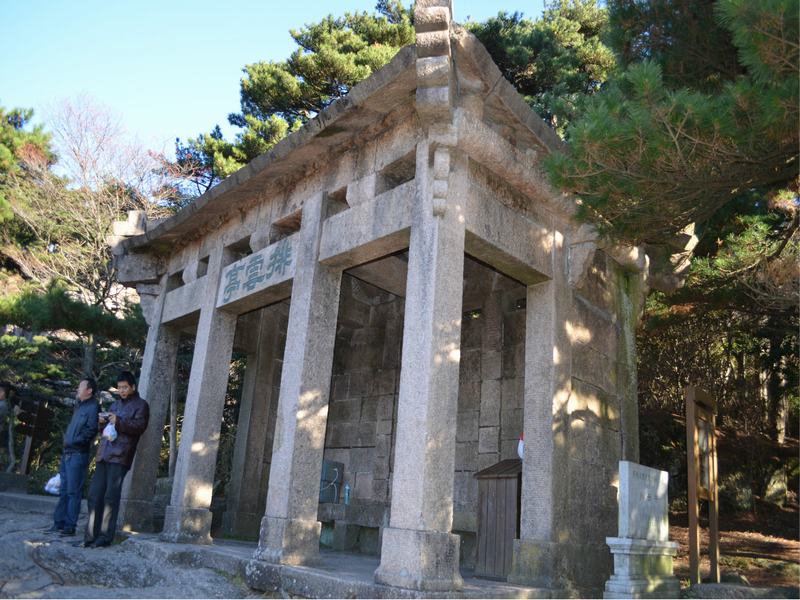
In 1606, a Buddhist monk named Pumen built the Fahai Buddha Hall on Mount Huangshan. Some years later, the Ming Dynasty emperor ordered Pumen to extend the hall and rename it Defending Country Mercy Light Temple (Ciguang Pavilion) —a name that survives today as one of the main cableway departure points and the gateway to the Front Mountain.
Following the temple‘s expansion, Pumen, together with people from She County, hacked through the undergrowth to create paths connecting the four main temples of the era: Cuiwei Temple, Xianfu Temple, Mercy Light Temple (Ciguang Pavilion), and Zhibo Temple. Afterwards, many monks flocked to Mount Huangshan to meditate and draw pictures of the mountain, building numerous houses and thatched cottages.
Qing Dynasty and Decline
During the early Qing Dynasty (1644–1911), the houses and temples were under government protection. However, in the late Qing Dynasty, many houses and some temples were destroyed due to neglect, as the number of pilgrims dwindled and the political situation became unstable.
The Birth of “Beginning-to-Believe Peak”
Over the centuries, many scenic spots and physical features on the mountain acquired colorful names, each with its own narrative. One of the most famous examples involves Shixin Peak (Beginning-to-Believe Peak) . According to legend, a man who did not believe the tales of Huangshan’s extraordinary beauty went to the mountain to see it for himself. Almost immediately upon arrival, he was converted to the same view, and one of the peaks he visited was later named Shixin Peak—roughly meaning “Beginning-to-Believe Peak.” The name captures the mountain‘s power to convert skeptics into believers, a theme echoed by countless travelers over the centuries.
The Xu Xiake Legacy: “Huangshan Tops All Mountains”
The Ming Dynasty (1368–1644) produced the most famous visitor in Huangshan’s history: Xu Xiake (1587–1641), China’s greatest traveler and geologist. Xu visited Mount Huangshan twice and praised it with a famous declaration: “Once on top of Mount Huangshan, one finds no other match — this is the acme!”
This quote was later refined by generations into two of the most celebrated lines in Chinese travel literature:
“After visiting the Five Sacred Mountains, you will not look at any other mountains; after visiting Huangshan, you will not look at any other mountains.”
The five sacred mountains (五岳 Wu Yue) refer to Mount Taishan in Shandong, Mount Huashan in Shaanxi, Mount Hengshan in Hunan, Mount Hengshan in Shanxi, and Mount Songshan in Henan. The saying captures the unique position Huangshan holds in China’s mountain hierarchy: it surpasses even the sacred peaks.
Xu continued to shape the mountain‘s reputation long after his death. In 1941, the Republic of China government posthumously named him a “geologist, traveler, and geographer”—an extraordinary honor for someone three centuries deceased.
Modern History: Republican Era (1912–1949)
The Construction Commission (1932)
In 1932, the government of the Republic of China took its first significant step toward organized mountain management by establishing the Construction Commission of Huangshan. This marked the beginning of systematic planning for the mountain as a public scenic area rather than a purely religious or pilgrimage site.
The First Major Infrastructure (1934)
In 1934, the commission accomplished two major engineering feats: building the road from Tangkou Town to Xiaoyao Pavilion and constructing the stone steps from Yungu Temple to the North Sea Scenic Area. These projects opened the rear (north) side of the mountain to travelers and laid the foundation for the modern trail system still used today.
The Huangshan Administration Bureau (1942)
In 1942, the government of the Republic of China established the Huangshan Administration Bureau and placed it under the jurisdiction of the Anhui provincial government, formalizing administrative oversight of the site.
Liberation (1949)
On April 27, 1949, the People‘s Liberation Army (PLA) liberated Huangshan City. The new communist government took over Mount Huangshan, initiating a new era of development and public access.
The Communist Era (1949–Present)
Post-Liberation Reconstruction (1950s)
Following the establishment of the People’s Republic of China, the government launched a program of infrastructure overhaul on Huangshan. In 1956, numerous mountain paths were reconstructed, and the road from Xiaoyao Pavilion to the Hot Spring Scenic Area was built. The same year saw the construction and public opening of several major facilities:
| Facility | Type |
|---|---|
| Guanpu Building | Viewing pavilion |
| Huangshan Hotel | Accommodation |
| Hot Spring Swimming Pool | Recreation |
| Yihai Building | Viewing structure |
In 1958, additional facilities followed: Beihai Hotel, New Spring Building, Lianyu Pavilion, and Guanyu Pavilion were constructed on the mountain, expanding the mountain’s capacity to host visitors.
Huangshan Administration of Anhui Province (1979)
In October 1979, a significant administrative restructuring occurred with the establishment of the Huangshan Administration of Anhui Province, consolidating management authority.
National Recognition (1982)
In 1982, Mount Huangshan was declared a “Site of Scenic Beauty and Historic Interest” by the State Council of the People‘s Republic of China, elevating its status within China’s national park system.
UNESCO World Heritage (1990)
On December 7, 1990, UNESCO officially inscribed Mount Huangshan on the World Heritage List for both its natural and cultural values.
Outstanding Universal Value: UNESCO recognized Huangshan for its extraordinary natural beauty—its massive granite boulders, ancient pines enhanced by cloud effects, and numerous imposing peaks—alongside its cultural significance, including ancient paths, bridges, pavilions, carvings, and inscriptions that have inspired literature and the influential Shanshui (“Mountain and Water”) school of landscape painting.
Sister Mountain with Jungfrau (2002)
In 2002, Mount Huangshan was named the “sister mountain” of Jungfrau in the Swiss Alps. Both mountains are UNESCO World Heritage sites, and the partnership was established to enhance exchanges in tourism and culture. In 2008, the two peaks deepened their cooperation by establishing a sister-city partnership. In 2025, marking the 75th anniversary of diplomatic relations between China and Switzerland, the two mountains held a joint photo exhibition and dialogue event further strengthening their bond.
UNESCO Global Geopark (2004)
On February 13, 2004, Huangshan was approved by UNESCO as one of the first Global Geoparks in the world, recognizing the site‘s extraordinary granite landforms and geological significance.
World Biosphere Reserve
Huangshan has also been designated a World Biosphere Reserve, completing a rare triple crown of UNESCO designations. The mountain is one of only eight locations worldwide that simultaneously hold UNESCO World Heritage (cultural and natural), Global Geopark, and Biosphere Reserve status. This achievement places Huangshan in an exclusive global circle of sites recognized for their outstanding universal value across natural, cultural, geological, and biological dimensions.
Ecological Achievements
Since its UNESCO inscription in 1990, Huangshan has made remarkable ecological progress:
• Forest coverage has increased from 56% at the time of inscription to 98.29%
• The mountain has maintained zero forest fires for 46 consecutive years
• Conservation management has consecutively received the IUCN’s highest “GOOD” rating
• In 2023, Huangshan was certified as China‘s first mountain-type “Zero-Carbon Scenic Area,” with forest carbon sequestration fully offsetting operational emissions
2026 Updates: Lotus Peak Reopening and UNESCO Dialogue
Lotus Peak Reopens (2026)
After a five-year ecological closure, Lotus Peak (Lianhua Feng) —the highest peak in the Yellow Mountain Scenic Area at 1,864 meters above sea level—reopened to the public on March 20, 2026. The peak, named for its resemblance to a lotus blossom with smaller peaks clustered around a large protruding area, had been closed as part of Huangshan’s long-established practice of rotating peak closures for environmental protection. This practice, initiated by Huangshan in 1987, has since been adopted by other mountain scenic areas across China. On the same day as Lotus Peak‘s reopening, Tiandu Peak began its own five-year ecological closure.
The Fifth UNESCO Huangshan Dialogue (May 31 – June 1, 2026)
Just days before the writing of this guide, Huangshan hosted the fifth UNESCO Huangshan Dialogue on UNESCO-designated Sites and Sustainable Development, a landmark event in the mountain‘s modern history. The conference was officially approved by UNESCO in April 2026 as the world’s first international academic conference under the UN’s “International Decade of Sciences for Sustainable Development” framework (2024–2033) focused on heritage site sustainability.
Key outcomes of the 2026 dialogue:
| Outcome | Details |
|---|---|
| Theme | “Digital and Smart Technologies Driving Sustainable Development of Designated Heritage Sites” |
| Global Participation | Over 200 representatives from 18 international organizations and 35 countries and regions |
| Major Launch | “Huangshan Designated Heritage Sites Empowering Comprehensive Regional Sustainable Development Action Plan” |
| Publication Release | “Global Cultural Heritage Remote Sensing Dynamic Monitoring Atlas (2020–2025)” |
| Conference Scale | Named “the world‘s first international academic conference under the UN Science Decade framework focusing on heritage site sustainability” |
The dialogue covered topics including AI and digital archaeology, climate change, biodiversity conservation, risk monitoring and assessment of heritage sites, sustainable tourism, and community development, with a dedicated session on UNESCO heritage site nomination and promotion.
This gathering of mayors and representatives from 10 countries, including Germany and Nepal, took place alongside another significant event—the 2026 World Mayors Dialogue in Huangshan (May 28–31), exploring heritage protection and urban development. The mayor of Stralsund, Germany, noted that Huangshan has delivered impressive outcomes in tech development, livelihood upgrades, and traditional culture protection.
AI and Digital Innovation at Huangshan (2026)
Huangshan has emerged as a pioneer in applying digital technologies to heritage conservation. The mountain has established a comprehensive Protection, Management and Command Center serving as the hub for digital operations and emergency coordination. AI applications in tourism are advancing, with intelligent hiking assistance devices completing public testing and moving toward commercial use.
The mountain has also deployed a large-scale drone network (“Sky Guardian” cluster) for forest resource monitoring, pine wilt disease control, high-altitude material transport, and emergency rescue. A “Smart Sky Network” monitoring system integrates high-definition surveillance, forest fire auto-alert systems, and real-time ecological environment monitoring, creating an integrated protection landscape described as “one source per data point, panoramic insight”.
At the 2026 dialogue, UNESCO World Heritage Centre Director Lazare Eloundou Assomo noted: “These technologies are not only helping us generate new global knowledge to better understand the state, contribution and resilience of UNESCO-designated sites. They are also providing increasingly powerful tools to improve management on the ground.”

Cultural Legacy: The Huangshan School of Painting
Perhaps no mountain in China has inspired as much art as Huangshan. The unique landforms and dramatic scenery of the mountain have given rise to the “Huangshan school” of landscape painting, which has had a lasting impact on Chinese art. The mountain’s granite peaks emerging from seas of clouds, twisted ancient pines clinging impossibly to cliffs, and ever-changing light have served as muse for countless painters over the centuries. UNESCO explicitly recognizes that the mountain “has inspired numerous pieces of literature, and originated the influential Shanshui (‘Mountain and Water’) school of landscape painting”.
Representatives of the Huangshan school include masters such as Jian Jiang (Hongren) of the early Qing Dynasty, whose spare, austere style captured the mountain’s essence, as well as Zha Shibiao, Sun Yi, and Mei Qing—artists who lived on or near Huangshan for extended periods, producing works that shaped the course of Chinese landscape painting.
The mountain’s cultural influence was further highlighted in **2019 with the debut of the large-scale panoramic performance **“The Legend of Huangshan,” a 60-minute multimedia experience that brings the mountain’s history, legends, and natural beauty to the stage. The show has become a popular attraction for visitors to Huangshan City.
Intangible Cultural Heritage
Huangshan UNESCO Global Geopark is home to three nationally recognized intangible cultural heritage elements:
| Intangible Cultural Heritage | Description |
|---|---|
| Huangshan Maofeng green tea production | One of China‘s ten most famous teas, known for its distinctive shape and floral aroma |
| Taiping Houkui tea processing techniques | A premium green tea with large flat leaves and a sweet, refreshing taste |
| Hui Opera | A traditional form of Chinese opera originating in Huizhou region, characterized by its spirited performances |
Additionally, Tangkou ham curing is preserved at the provincial level. Institutional measures ensure the safeguarding and transmission of these traditions, including the establishment of legal frameworks and identification systems for local knowledge holders.
The “Five Wonders” of Huangshan
While different sources sometimes categorize Huangshan‘s wonders differently, the most widely recognized set is the “Five Wonders” (五绝): strangely-shaped pines, fantastic rocks, sea of clouds, hot springs, and winter snow. Some classifications present only “Four Wonders” when winter snow is not included, but the contemporary standard lists five, reflecting the mountain’s stunning winter rime and snowscapes.
| Wonder | Details |
|---|---|
| Strange Pines | Huangshan’s ancient pines grow horizontally from vertical cliff faces, shaped by centuries of high-altitude winds. The 1,500-year-old Welcoming Guests Pine (Yingke Song) is the most famous |
| Fantastic Rocks | Grotesque rock formations with evocative names like “Monkey Watching the Sea” and “Rock That Flew from Afar” |
| Sea of Clouds | For more than 200 days each year, mist coagulates into a sea of clouds that makes visitors feel as though they are in a fairyland |
| Hot Springs | Natural hot springs at the mountain‘s base have been used for relaxation and healing for centuries |
| Winter Snow / Rime | The spectacle of rimed trees sparkling in the sun—clusters of frosty corals that appear only when temperatures drop sufficiently |
Key Facts Summary
| Aspect | Detail |
|---|---|
| Total Mountain Area | Approximately 1,200 square kilometers |
| Scenic Area | 160.6 square kilometers |
| Dimensions | 40 km north–south × 30 km east–west |
| Number of Peaks over 1,000m | 72 peaks |
| Highest Peak | Lotus Peak (Lianhua Feng) — 1,864.8 m — open in 2026 after five-year closure |
| Steepest Peak | Tiandu Peak (Heavenly Capital Peak) — closed for ecological restoration in 2026 |
| Flattest Peak | Bright Summit (Guangming Ding) — 1,840.4 m |
| UNESCO Inscription | 1990 (World Cultural and Natural Heritage) |
| UNESCO Global Geopark | 2004 (among first in the world) |
| World Biosphere Reserve | Designated (year of inscription not specified) |
| Triple UNESCO Designation | One of only 8 sites worldwide with World Heritage (cultural+natural), Global Geopark, and Biosphere Reserve |
| IUCN Rating | Highest “GOOD” rating — received consecutively since 2014 |
| Forest Coverage | 98.29% (up from 56% at time of UNESCO inscription) |
| Zero Fire Incidents | 46 consecutive years |
| Zero-Carbon Status | First mountain-type Zero-Carbon Scenic Area in China (2023) |
| Forestry / Green Ratio | Forest coverage rate 98.29%; greening rate 98.53% |
| Annual Visitors | Average of nearly three million visitors per year |
Modern Recognition and Global Standing
China’s “Top of Mountains” Symbol
Along with the Yellow River, the Yangtze River, and the Great Wall, Mount Huangshan is recognized as one of the four symbols of China’s magnificent landscapes. It is widely considered the “most gorgeous mountain in the world”. Domestically, Huangshan holds China‘s highest designations:
• National 5A Tourist Attraction (the highest rating in China’s tourism quality classification system)
• National Scenic Area of China
• National Civilized Scenic Area
Zero-Carbon Scenic Area Pioneer
In 2023, Huangshan achieved a historic milestone: it was certified as China‘s first mountain-type “Zero-Carbon Scenic Area.” Through comprehensive carbon accounting, the forest carbon sequestration in the Huangshan Scenic Area has fully offset the operational carbon emissions of the scenic zone. This achievement has been accomplished through green operational models including “touring up the mountain, staying down the mountain,” “clean supplies up, waste down,” and public participation mechanisms such as “public welfare point supermarkets” that guide visitors to join in ecological protection.
Global Recognition of Conservation
In recognition of its world-class conservation standards, Mount Huangshan was added to the IUCN Green List of Protected Areas, a global standard recognizing effectively managed and fairly governed protected areas. The mountain’s conservation management has been evaluated four consecutive times under IUCN‘s triennial assessment (since 2014), each time receiving the highest possible rating.
Huangshan‘s conservation achievements are internationally recognized. The mountain is one of only eight locations worldwide simultaneously holding the triple UNESCO designations of Cultural and Natural World Heritage, Global Geopark, and Biosphere Reserve — a level of recognition given to only a handful of sites globally.
In February 2025, at the China National Forestry and Grassland Administration‘s press conference releasing *“The Development and Protection Report of World Natural Heritage in China (1985-2025)”* commemorating 40 years of World Heritage in China, Huangshan Scenic Area was invited as a representative example to share its experience. The scenic area systematically introduced its innovative practices and achievements in heritage protection, management, and utilization, presenting to both domestic and international audiences the “Huangshan wisdom” of harmonious coexistence between humanity and nature.
How Huangshan Got Its English Name
The mountain’s English designation, “Yellow Mountain,” is a literal translation of “Huangshan” (黄山). The name does not reference the color of the mountain’s rocks or soil. Rather, it honors the mythological Yellow Emperor (Huangdi). This point is often misunderstood by international visitors who expect to see yellow stone. In fact, the mountain’s original name “Mount Yi” (黟山) means “black mountain,” referring to its dark appearance from a distance. Understanding this etymology adds an important layer of appreciation for the cultural depth behind one of China’s most photographed natural landmarks.
There are some records suggesting the name “Black Mountains” (黑山) was also used in certain contexts prior to the Tang Dynasty renaming.
Final Words
Mount Huangshan is not merely a mountain—it is a living archive of geological time, religious history, artistic inspiration, and conservation innovation. Its granite peaks have watched over 140 million years of Earth’s history, witnessed the rise of Taoism and the arrival of Buddhism, inspired the world’s most celebrated landscape paintings, and now serve as a global model for sustainable heritage management.
The ancient Chinese saying remains true:
“After visiting the Five Sacred Mountains, you will not look at any other mountains; after visiting Huangshan, you will not look at any other mountains.”
For those who make the journey to Huangshan, the mountain offers not just spectacular scenery, but a profound connection to the deepest currents of Chinese civilization—and a glimpse of what happens when nature, history, and human care come together in perfect harmony.
More Recommend
- Huangshan Sunset Guide
- Huangshan Sunrise Guide
- Huangshan North Railway Station
- How to Get to Huangshan
- Hangzhou to Huangshan High Speed Train
- Huangshan Festivals and Events
- Huangshan Summit Hotels Guide
- How to Get from Shanghai to Huangshan
- Huangshan to Shanghai High Speed Train
- Shanghai to Huangshan High Speed Train


