Hongcun Village
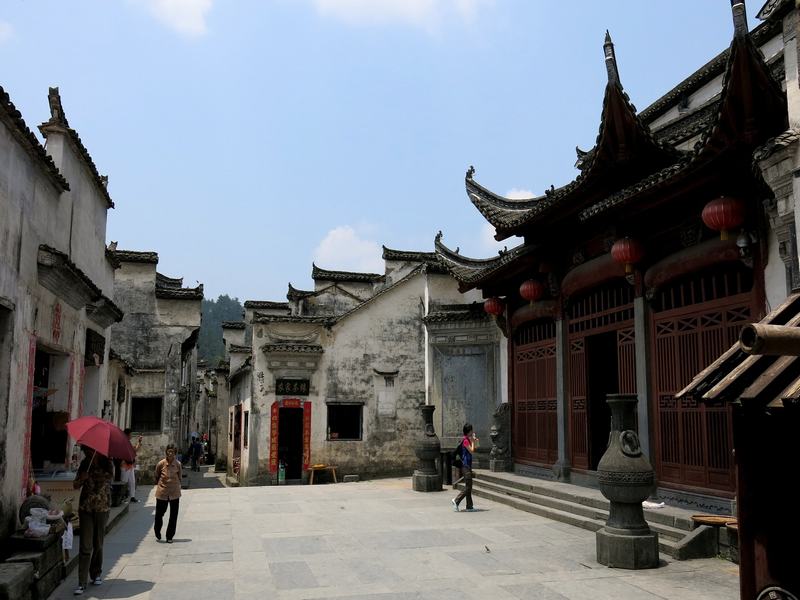
Located 11 kilometers southwest of Yi County, at the southwestern foot of Mount Huangshan (Yellow Mountain), Hongcun Village is a UNESCO World Heritage site renowned for its ingenious ox‑shaped layout and exceptionally preserved Ming and Qing dynasty architecture. In ancient times, this village served as a gateway for merchants traveling to the capital.
Overview
The village covers 28 hectares, of which 19.11 hectares form the protected ancient core. Here, 158 folk houses from the Ming (1368–1644) and Qing (1644–1911) dynasties remain standing, with 137 completely intact. The village is laid out with its main street as the central axis, backed by Leigang Mountain, bordered by the Moon Pond to the north, South Lake and Qishu Lake to the south, and flowing waters that connect to the Yangtze River and Sui Stream.
The Ox‑Shaped Layout – A Feng Shui Masterpiece
Hongcun is famously called the “Ox‑shaped Village” because its design mimics the animal:
•Head: The high Leigang Mountain
•Horns: Tall green trees at the entrance
•Body: The dense cluster of houses
•Stomach: The clear ponds (Moon Pond and South Lake)
•Intestines: The winding water channels running between houses
•Legs: Four bridges protruding outward
The village rests peacefully like an ox at ease, embraced by green mountains and fertile farmland – a perfect example of ancient Chinese Feng Shui planning.
Main Attractions
| Attraction | Highlights |
|---|---|
| South Lake Academy | Originally six private schools (late Ming), merged in 1814 into one academy. A representative ancient Hui‑style school, now under provincial protection. |
| Lexu Hall | Also called “Hall of All Families” – the primary ancestral shrine of the Wang clan, built in the Ming Dynasty north of Moon Pond. |
| South Lake | A 2‑hectare man‑made lake (dug 1607) shaped like a large bow, praised as “the minor West Lake at the foot of Huangshan.” |
| Moon Pond | A crescent‑shaped pond at the village center – the “stomach” of the ox. Famous for the scene “Early Spring at Moon Pond.” |
| Water Conduit (Ox Intestine) | The winding channel that brings water from Shijie (“ox tongue”) into the village, creating the scene “Water Ripples at Shijie.” |
| Chengzhi Hall | Built in 1855 for Wang Ding‑gui, a prominent salt merchant of the late Qing Dynasty. Now a key provincial protected historical site. Known for exquisite wood carvings. |
| Lexian Hall | Built 1699 on the main street. One of the “three primary halls” (with Sanli Hall and Baoyi Hall), under provincial protection. |
| Deyi Hall | A waterside residence built 1815, only 220 m² but arranged like a garden with bonsai and flowers. |
| Green Garden | A waterside mansion near the water conduit’s source. First built late Ming, restored 1825. Features courtyard, garden, pond, tower pavilion, and a wood carving tower. |

Why Visit Hongcun?
•One of the most beautiful ancient water towns in southern Anhui
•UNESCO World Heritage designation (cultural landscape)
•Authentic Ming‑Qing architecture without over‑commercialization
•Living village – locals still use the ancient water channels
•Filming location for Crouching Tiger, Hidden Dragon (scenes at Moon Pond and South Lake)
Whether you are a photographer, history lover, or traveler seeking an authentic Chinese village experience, Hongcun offers an unforgettable journey into the elegance of ancient Huizhou culture.


